
Published: Monday, September 22, 2025 · 12:08 PM | Updated: Monday, September 22, 2025 · 12:08 PM
📊 496 views




Introduction
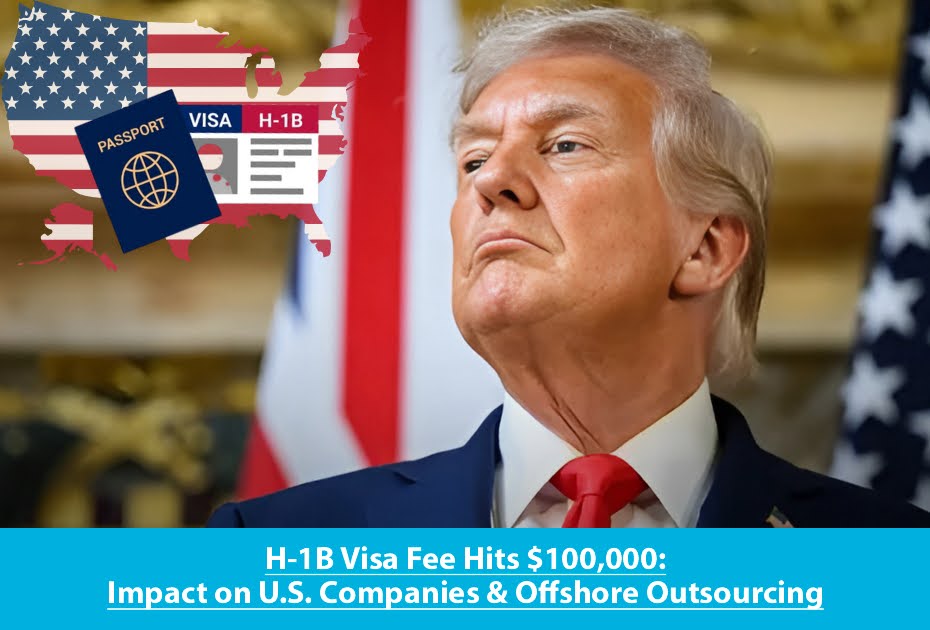
The U.S. tech industry thrives on innovation, but it also depends heavily on skilled talent from around the world. For decades, the H-1B visa program has been the bridge connecting U.S. companies with global professionals. In 2025, however, that bridge just became much more expensive. The U.S. government has raised the fee for new H-1B visa applications to $100,000, sparking concern across industries. This change not only affects how companies hire but also forces them to rethink long-term workforce strategies. In this article, we’ll break down what the new fee means for businesses — and why offshore outsourcing remains a safe, cost-effective way to access the talent they need.
Summary
1. What Changed With the H-1B Visa
2. How This Impacts U.S. Companies
1. What Changed With the H-1B Visa
In September 2025, the U.S. government announced a sharp increase in fees for new H-1B visa fee raising the cost to $100,000 per petition.
- The fee applies only to new applications.
- Existing visa holders, renewals, or petitions filed before September 21, 2025 are not affected.
- The move is intended to reduce over-reliance on foreign workers and push companies toward hiring U.S. talent.
2. How This Impacts U.S. Companies
- Higher hiring costs – Companies now face visa expenses that can exceed salaries for entry-level roles.
- Talent shortages – U.S. tech firms already struggle to find specialized talent domestically; the fee makes global hiring harder.
- Strategic shifts – Businesses will consider alternative models like remote teams, nearshore development centers, or offshore outsourcing.
- Uncertainty & disruption – Rapid policy changes create planning challenges for HR and operations teams.
3. Why Offshore Outsourcing Remains a Smart Option
Instead of absorbing the $100,000 visa fee, many companies are turning to offshore outsourcing — hiring skilled teams abroad without bringing them into the U.S.
|
Benefit |
Why It Matters |
|
Cost savings |
Outsourcing avoids expensive visa fees and provides access to competitive labor markets. |
|
Access to talent |
Countries like India, the Philippines, and Eastern Europe have strong pools of IT, AI, and software professionals. |
|
Scalability |
Teams can be scaled up or down quickly without U.S. immigration bottlenecks. |
|
Lower legal risk |
Offshore hiring avoids constant policy shifts in U.S. immigration. |
4. Common Concerns (and How to Address Them)
The new $100,000 H-1B visa fee is a game-changer for U.S. companies that rely on foreign talent. While some businesses will continue using H-1B visas for critical on-site roles, many will find the costs too high and the risks too uncertain.
That’s why offshore outsourcing is increasingly the safer, more flexible, and more cost-effective strategy. With the right partners, U.S. companies can continue to access world-class talent—without the burden of skyrocketing visa costs.
Conclusion
The $100,000 H-1B visa fee marks a turning point for U.S. companies. While it may discourage over-reliance on foreign workers entering the country, it also raises costs and uncertainty for businesses that need specialized skills. The good news is that global talent is still within reach — just not always within U.S. borders. Offshore outsourcing offers a practical, proven solution that delivers cost savings, flexibility, and access to highly skilled professionals without the burden of visa challenges.
👉 For forward-looking companies, outsourcing isn’t simply a backup plan — it’s becoming a strategic advantage in a changing business landscape.
MORE IN INSIDE ECONOMY
China Industrial Profit Growth: A Slowing Expansion Amidst Economic Headwinds
Published: Sunday, September 27, 2026 · 11:09 PM
US-China Trade Stability: A Surprise Jump in Orders Signals De-escalation
Published: Friday, September 25, 2026 · 8:19 AM


