Published: Monday, July 20, 2026 · 8:28 PM | Updated: Monday, July 20, 2026 · 8:28 PM
📊 250 views




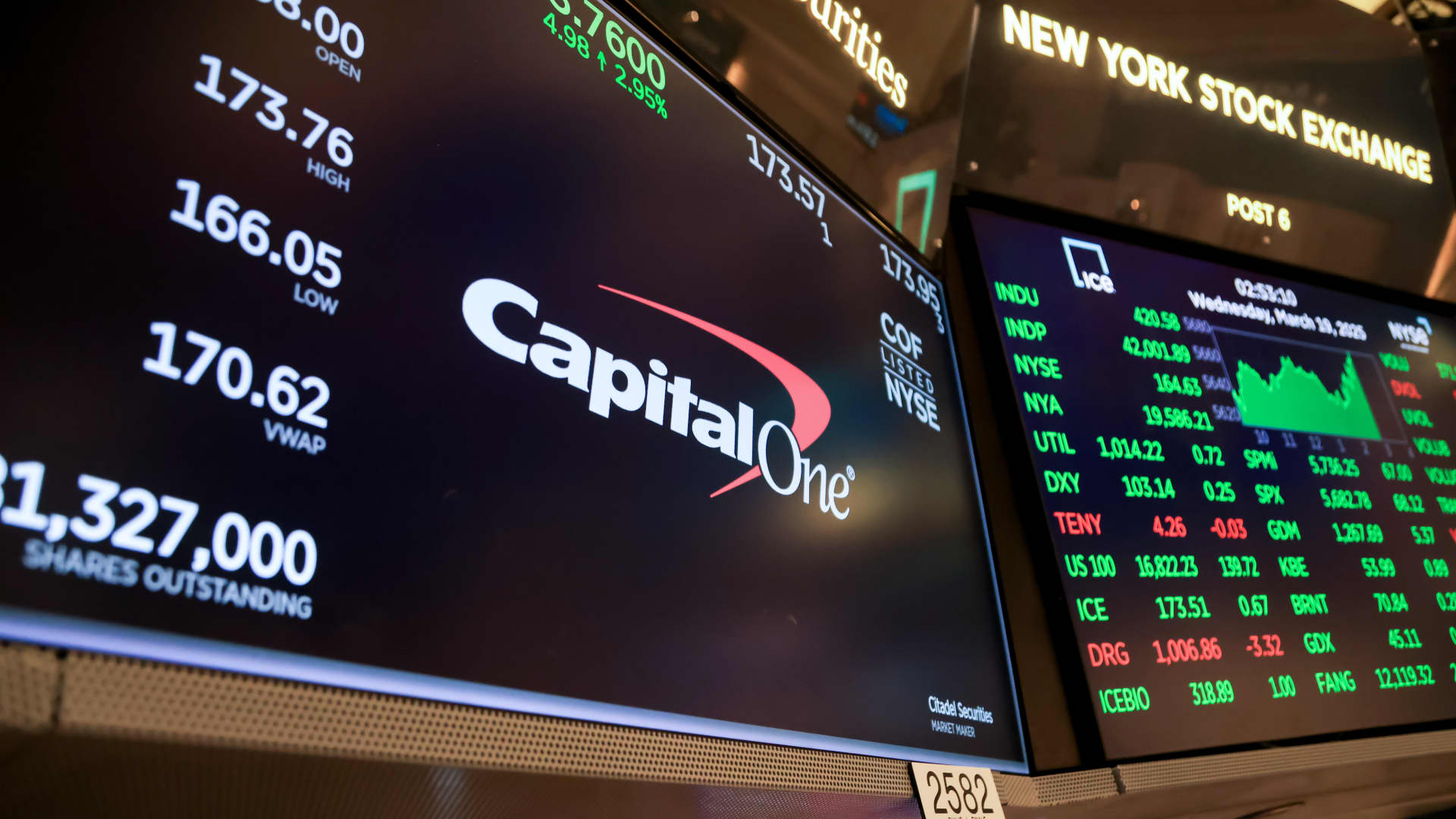
Capital One is at a pivotal juncture, facing intense investor scrutiny as it prepares to report second-quarter results. The colossal $35 billion Capital One Discover Acquisition, intended as a transformative move, has yet to convince the market, with the company grappling with integration costs and a hesitant stock performance.
💰 Financial Strategy & Market Insights
- Q2 Earnings Criticality. Capital One’s second-quarter earnings report is paramount for CEO Richard Fairbank to validate the strategic value and future profitability of the Discover deal, following successive profit misses and $1.8 billion in integration expenses.
- Synergy Targets Under Pressure. Management must provide clear pathways to achieving its aggressive targets of over 15% EPS accretion and $2.7 billion in annual synergies by 2027, particularly by detailing cost savings from leveraging Discover’s payment network.
- K-Shaped Economy Vulnerability. Despite a recent stock rally, Capital One faces significant risk from a ‘K-shaped economy’ due to its substantial exposure to subprime borrowers, potentially increasing defaults amidst persistent inflation and affordability concerns.
The Capital One Discover Acquisition has thrust the credit card giant into a period of elevated expectations and operational challenges. With Q2 results on the horizon, CEO Richard Fairbank is under pressure to articulate how the $35 billion investment will translate into sustained shareholder value, especially after two consecutive quarters of profit misses driven by higher-than-expected expenses, totaling $1.8 billion in integration costs since May 2026. The market, as tracked by LSEG, is looking for Q2 EPS of $4.75 on revenue of $15.77 billion, figures that would represent sequential improvements.
The strategic rationale behind the Capital One Discover Acquisition is clear: gain control over a proprietary payment network. By shifting its vast credit card base onto Discover’s network, Capital One aims to mitigate the substantial fees currently paid to Mastercard and Visa. This move is projected to enhance profitability and position Capital One more akin to integrated players like American Express, further bolstered by its recent acquisition of corporate expense management platform Brex. While debit card conversions are largely complete, the more impactful credit card migration is slated for next year, requiring ongoing communication to investors about this complex, multi-year transition.
Market experts like Jim Cramer emphasize the need for Fairbank to “rationalize the business” and connect the dots between current investments and future returns. Jeff Marks, a Club portfolio director, echoed this sentiment, stating that shareholders are now eager to see the realization of cost synergies, not just continued heavy investments. This focus on controllable variables is particularly important given external pressures that have weighed on Capital One shares, including economic uncertainty, the lingering threat of regulatory intervention on credit card rates, and elevated inflation impacting consumer spending. For a broader perspective on market analysis, you can always visit StockXpo’s comprehensive market analysis.
Adding to the complexity, the US economy’s ‘K-shaped’ recovery presents a unique risk profile for Capital One. As Argus analyst Stephen Biggar highlighted, while wealthier households thrive, lower-income families face squeezed budgets, a dynamic that disproportionately impacts Capital One’s business given that credit cards constitute roughly 70% of its operations and it has higher exposure to subprime borrowers. Biggar also pointed to the company’s “fairly large” reserve build last quarter, which the market might interpret as an expectation of deteriorating credit quality. Conversely, Wells Fargo CEO Charlie Scharf’s recent comments on strong consumer spending and lower charge-offs offer a glimmer of optimism for the broader consumer lending landscape.
- Strategic Imperative: The Capital One Discover Acquisition aims to establish an owned payment network, reducing reliance on Mastercard and Visa, thereby capturing a significant cost advantage and expanding revenue streams.
- Operational Hurdles: Integration expenses of $1.8 billion and a multi-year timeline for full credit card network migration underscore the complexity and upfront costs of achieving promised synergies.
- Macroeconomic Headwinds: Factors such as persistent inflation, potential interest rate hikes, and the ‘K-shaped economy’ pose challenges, particularly for Capital One’s subprime borrower portfolio.
Risk vs. Reward in the Capital One Discover Acquisition
- Upside Potential:
- Realization of $2.7 billion in annual synergies by 2027, significantly boosting profitability.
- Enhanced competitive positioning with an owned payment network, reducing transaction costs and offering greater control over product development.
- Expansion into new segments, such as corporate expense management via Brex, diversifying revenue streams and client base.
- Positive market reaction if Q2 earnings exceed estimates and management clearly outlines synergy realization.
- Downside Risks:
- Failure to achieve stated synergy targets due to integration difficulties or competitive pressures.
- Increased credit defaults and loan losses if the ‘K-shaped economy’ further pressures lower-income borrowers.
- Ongoing integration expenses weighing heavily on earnings, eroding investor confidence.
- Regulatory scrutiny or adverse policy changes impacting credit card rates and fees.
- Negative sentiment if Q2 results miss expectations or strategic clarity remains elusive.
In financial markets, a ‘K-shaped economy’ describes a post-recession recovery where different parts of the economy recover at different rates, forming a ‘K’ shape on a graph. Typically, some sectors or demographics (e.g., wealthy, tech workers) experience robust growth, while others (e.g., lower-income households, traditional industries) struggle, exacerbating wealth inequality and creating distinct risk profiles for lenders like Capital One with diverse client portfolios.
Key Financial Metrics for Capital One
| Metric | Value/Target | Source/Context |
|---|---|---|
| Acquisition Cost (Discover) | >$35 billion | Capital One |
| Integration Expenses (since May) | $1.8 billion | Q1 Securities Filing |
| Q2 EPS Estimate | $4.75 | LSEG |
| Q2 Revenue Estimate | $15.77 billion | LSEG |
| Annual Synergies Target | $2.7 billion (by 2027) | Capital One |
| EPS Accretion Target | >15% | Capital One |
| Forward P/E | ~9x | Market Data |
Capital One Market Sentiment Tracker: Investor Jitters and Expectations
Investor sentiment around Capital One has been highly volatile, oscillating between cautious optimism fueled by the long-term strategic vision of the Capital One Discover Acquisition and significant apprehension over near-term execution and macroeconomic headwinds. Despite a recent 20% rally from its 52-week low, the stock still lags its all-time highs by approximately 24%, reflecting lingering doubts. The market is keenly awaiting definitive proof that the integration expenses are investments yielding tangible future returns, rather than merely costs. Analysts like Jim Cramer describe Capital One as the “cheapest major bank in the country” based on its forward earnings multiple, suggesting underlying value if management can deliver. However, the pre-earnings stock spike raises the bar for Q2 performance. For continuous financial industry updates, readers can consult reliable financial industry updates.
Capital One Historical Benchmarking: Tracing Performance Against Peers
Comparing Capital One’s trajectory with industry peers reveals its unique challenges and opportunities. While major banks like Wells Fargo are reporting robust consumer health metrics, Capital One’s higher exposure to subprime credit places it in a more vulnerable position amidst an uneven economic recovery. The strategic pivot to an owned payment network, a capability shared by American Express, aims to differentiate Capital One in the long run. However, the path to achieving Amex-like integration and profitability is laden with execution risk. Historically, acquisitions of this magnitude have a mixed track record, demanding exceptional leadership and operational discipline to unlock value. Understanding historical financial trends is key to navigating the complex financial sector.
Capital One’s Strategic Convergence: The Path Ahead
Capital One’s Q2 earnings report is more than just a quarterly update; it’s a critical referendum on the Capital One Discover Acquisition. The company must demonstrate not only operational efficiency in managing integration costs but also a clear, compelling narrative for how Discover transforms its market position and financial outlook.
- Management needs to provide granular details on synergy capture and the timeline for credit card network migration.
- Addressing concerns about the ‘K-shaped economy’ and its impact on credit quality is paramount for investor confidence.
- The stock’s recent rally adds pressure for a strong beat and a clear strategic vision to avoid a post-earnings pullback.
Will Capital One successfully prove its $35 billion bet was a strategic masterstroke, or will the market demand a re-evaluation of its growth trajectory?
📊 StockXpo Analyst’s View
Market Impact: The outcome of Capital One’s Q2 earnings will significantly influence investor sentiment across the broader consumer finance and payments sector. A strong showing could inject much-needed confidence, particularly for companies with consumer-linked assets, suggesting resilience against macroeconomic pressures. Conversely, any missteps or lack of clarity could amplify fears regarding credit quality and the viability of large-scale financial integrations, potentially triggering broader market cautiousness. Accessing valuable educational insights can help investors interpret these market signals.
Sector To Watch: The credit card and consumer lending sector remains a focal point. While higher interest rates can boost revenue, the risk of increased defaults in a K-shaped economy is a critical balancing act. Companies with diversified income streams or less exposure to subprime borrowers may fare better. Additionally, the payment processing industry, particularly the incumbents like Mastercard and Visa, will be watching Capital One’s network migration closely, as successful in-sourcing could set a precedent for other large issuers, impacting future fee structures and competitive dynamics. For global market trends, consider consulting Bloomberg’s global market trends.
Financial Disclaimer:
StockXpo.com is a financial news aggregator and educational portal, not a registered investment advisor or broker-dealer. All information, news, and analysis provided herein are strictly for educational purposes and do not constitute investment, financial, legal, or tax advice. Investing in the stock market involves high risks, and past performance is not indicative of future results. StockXpo will not be liable for any financial losses or investment damages. Always consult a certified financial advisor before making market decisions.
MORE IN INSIDE FINANCE

Diesel Prices: Goldman Sachs Predicts Sustained Highs Through 2027 Amid Refinery Volatility
Published: Tuesday, October 6, 2026 · 6:03 AM

Brazilian Stocks Jump: Political Shift Ignites Market Volatility
Published: Monday, October 5, 2026 · 1:50 PM