Published: Tuesday, July 14, 2026 · 11:03 PM | Updated: Tuesday, July 14, 2026 · 11:03 PM
📊 225 views




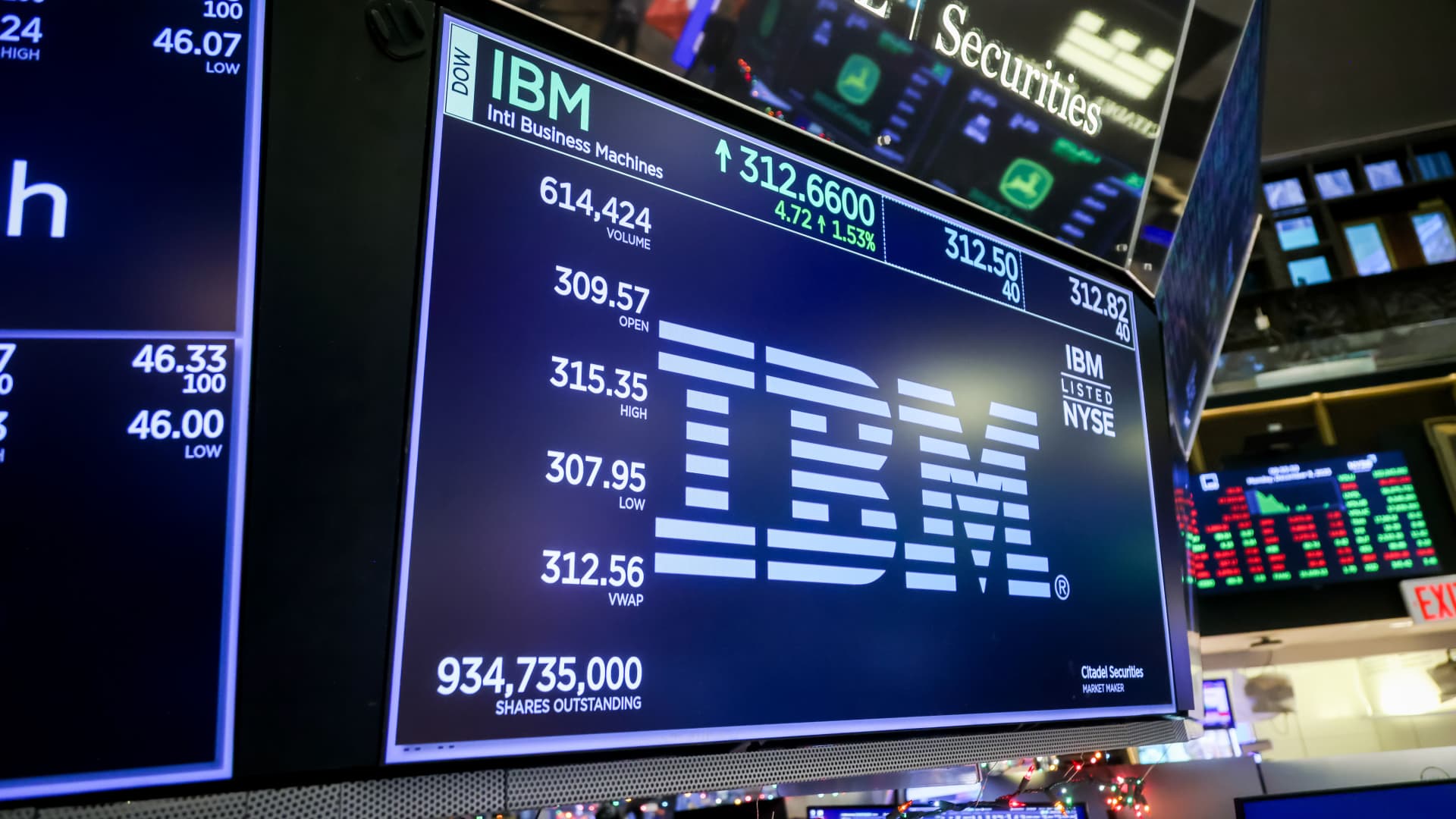
IBM shares experienced a significant 25% decline following the company’s preannouncement of disappointing second-quarter results, underscoring a pivotal shift in corporate IT spending priorities. This downturn signals a challenge for established tech players as budgets increasingly reallocate towards emergent technologies.
🚀 Tech Strategy & Market Disruptions
- AI-Driven Budget Reallocation. Enterprises are prioritizing AI investments, diverting funds from broader IT projects.
- Cybersecurity and Hardware Dominance. Critical infrastructure and security are becoming non-negotiable spending areas.
- IBM’s Product Portfolio Challenge. A significant portion of IBM’s offerings falls outside these top three IT spending categories, creating headwinds.
CNBC’s Jim Cramer pointed to the sharp stock fall as evidence that IBM is caught on the wrong side of a major pivot in how companies allocate their technology budgets. He noted that while IBM has an ‘AI narrative,’ its extensive product and service portfolio includes many offerings now relegated to ‘other types of spending,’ which are being deprioritized.
The shortfall in revenue, earnings, and software revenue growth, coupled with CEO Arvind Krishna’s acknowledgment of faltered customer deals, reflects a broader market trend. As businesses finalize their 2027 IT budgets, the emphasis is clearly on three core areas: artificial intelligence, cybersecurity, and essential hardware. This strategic refocusing presents a direct challenge to companies whose strengths lie in less prioritized segments of the technology landscape.
This shift in corporate IT expenditure creates a ripple effect across the technology sector. Companies that can adapt and align their offerings with these burgeoning priorities are poised for growth, while those that cannot risk facing sustained pressure. The urgency for IT managers to align with these dominant trends underscores the dynamic nature of innovation-driven growth and the need for continuous strategic recalibration.
The implications for companies like IBM are profound. While Krishna’s candidness and the company’s long-term assets, including a dividend yield exceeding 3%, are acknowledged positives, they are currently overshadowed by the fundamental reordering of IT spending. Investors are watching closely to see how quickly IBM can pivot its strategy to capitalize on these new market demands, especially as competitors aggressively pursue the high-growth AI and cybersecurity sectors.
Understanding the AI Investment Surge
The acceleration of artificial intelligence spending is reshaping the technology market at an unprecedented pace. Businesses are no longer viewing AI as a futuristic concept but as an immediate necessity for competitive advantage. This includes not only the development and deployment of AI models but also the underlying infrastructure and talent required to support them.
This focus on AI, cybersecurity, and hardware expenditure means that other technology projects, which may have previously received significant investment, are now being deferred or cut. For established enterprises like IBM, navigating this transition requires a strategic re-evaluation of their product roadmaps and market positioning. The ability to seamlessly integrate AI capabilities or fortify their cybersecurity offerings will be critical for future success, as highlighted by analyses from leading financial news outlets like Bloomberg Technology.
The current market sentiment indicates a clear bias towards technologies enabling immediate operational efficiencies and future-proofing, with AI and cybersecurity at the forefront. Companies that can demonstrate tangible ROI in these areas will attract capital, while those with legacy product suites may face significant integration challenges.
IBM’s Platform Architecture Challenges
IBM’s extensive enterprise software portfolio, built over decades, presents a complex architectural challenge in an era demanding agile, AI-native solutions. While the company possesses strengths in areas like hybrid cloud and consulting, its traditional software products may not inherently align with the ‘AI tokens’ and consumption-based models that are rapidly gaining traction. The integration of new AI capabilities into existing platforms, or the development of entirely new, AI-first architectures, will be crucial. This requires not just technological upgrades but a fundamental shift in how services are packaged, priced, and delivered to meet the evolving demands of cloud-native environments and AI-driven workflows.
IBM’s Market Adoption Challenges
The primary hurdle for IBM lies in its current product mix versus the three key areas of IT spending: AI, cybersecurity, and hardware. Cramer’s observation suggests that a substantial portion of IBM’s offerings falls into categories that are now being deprioritized by budget-conscious enterprises. This necessitates a challenging strategic pivot, where the company must either rapidly innovate to integrate its existing services with AI or divest from less profitable legacy product lines. The market is signaling a clear preference for solutions that directly address these critical growth areas, making IBM’s ability to adapt its go-to-market strategy and product development cycles paramount to regaining investor confidence.
IBM’s AI Spending Landscape
The current IT budget allocation trends, prioritizing AI, cybersecurity, and hardware, place IBM at a critical juncture. As companies like IBM navigate this evolving landscape, their ability to demonstrate clear value propositions in these high-demand sectors will be key. The focus on ‘AI tokens’ signifies a move towards outcome-based IT investments, where the consumption of AI-driven services dictates budget allocation rather than the purchase of traditional software licenses. For IBM, this means a potential shift from selling broad enterprise solutions to offering more granular, AI-powered services that can be directly measured by their contribution to business objectives. This dynamic is a significant market disruption that will favor agile and AI-native technology providers.
IBM’s Evolving Market Position
The recent market performance of IBM underscores a broader industry trend: the increasing demand for specialized, AI-centric technologies. While IBM possesses a robust AI narrative and established long-term businesses, its stock’s significant decline highlights investor concerns about its current product portfolio’s alignment with these critical IT spending priorities. Competitors focusing on next-generation AI platforms and advanced cybersecurity solutions are capturing significant market share, forcing companies like IBM to accelerate their innovation cycles. The market’s reaction to IBM’s preannouncement is a stark reminder that continuous adaptation and strategic foresight are essential for sustained growth in today’s rapidly evolving technology sector, as analyzed by Reuters Technology.
IBM Faces a Crucial Budget Rebalancing Act
IBM’s future trajectory hinges on its ability to navigate the intense focus on AI, cybersecurity, and hardware within corporate IT budgets. While the company’s long-standing market presence and dividend offer some stability, the current market sentiment suggests that these factors are insufficient to offset concerns about its product alignment with emerging priorities. The coming months will be critical for IBM to demonstrate concrete strategies for capitalizing on the AI revolution and reinforcing its position in the cybersecurity landscape.
- IBM must accelerate its AI integration and innovation to directly address the ‘AI tokens’ market.
- Realigning its extensive product and service portfolio to emphasize cybersecurity and essential hardware will be vital.
- Demonstrating tangible growth and adaptation in these prioritized sectors is key to regaining investor confidence.
Will IBM’s leadership successfully pivot its innovation engine to capture the burgeoning AI and cybersecurity markets, or will it continue to be challenged by shifting corporate IT spending?
📊 StockXpo Analyst’s View
Market Impact: The significant decline in IBM’s stock, driven by shifts in corporate technology spending, indicates a broader market recalibration. Investors are favoring companies with strong AI and cybersecurity offerings, potentially leading to increased volatility for those whose portfolios are less aligned.
Sector To Watch: The cybersecurity and AI infrastructure sectors are likely to see sustained investor interest. Companies that can provide scalable, secure, and AI-driven solutions will be well-positioned to attract capital and achieve innovation-driven growth.
Financial Disclaimer:
StockXpo.com is a financial news aggregator and educational portal, not a registered investment advisor or broker-dealer. All information, news, and analysis provided herein are strictly for educational purposes and do not constitute investment, financial, legal, or tax advice. Investing in the stock market involves high risks, and past performance is not indicative of future results. StockXpo will not be liable for any financial losses or investment damages. Always consult a certified financial advisor before making market decisions.
MORE IN INSIDE TECHNOLOGY

SoftBank AI Investment: Malaysia’s $50 Billion Innovation Surge
Published: Monday, October 26, 2026 · 2:37 AM

SpaceX AI Chips: $40 Billion Deal Fuels Innovation-Driven Growth
Published: Sunday, October 25, 2026 · 9:35 PM