Published: Friday, June 5, 2026 · 8:03 AM | Updated: Friday, June 5, 2026 · 2:57 PM
📊 1,095 views




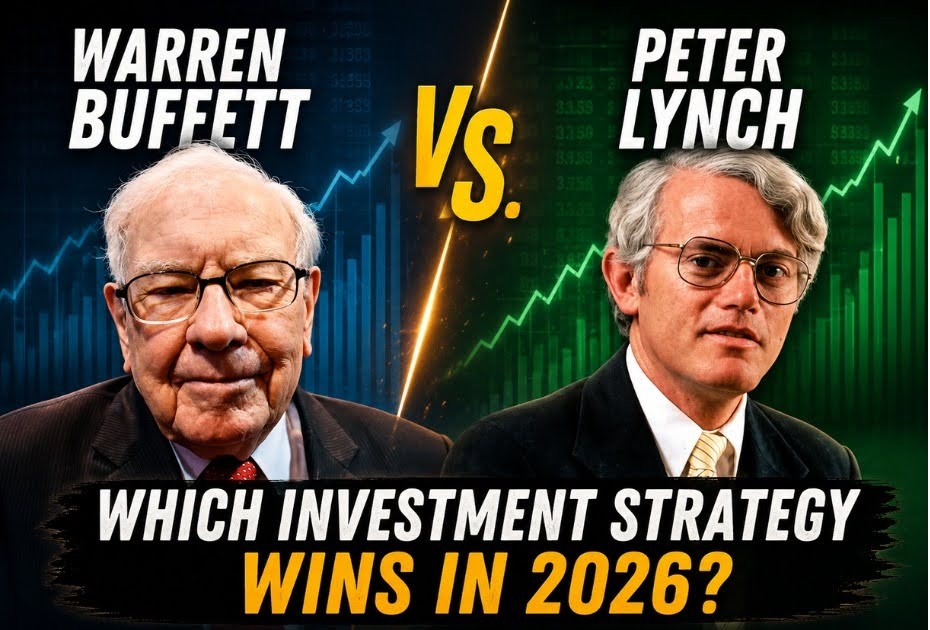
Two names dominate every serious conversation about stock market investing: Warren Buffett and Peter Lynch. One built his empire by holding exceptional businesses for decades. The other beat Wall Street 13 years straight by finding fast-growing companies before anyone else noticed them.
Both are legends. But in 2026’s market — shaped by AI disruption, elevated interest rates, and shifting consumer behavior — which strategy actually works better for today’s investor?
Let’s break it down.
Who Is Warren Buffett and What Is His Strategy?
Warren Buffett, Chairman and CEO of Berkshire Hathaway, is widely regarded as the greatest investor of the 20th and 21st centuries. His net worth has consistently ranked among the top five globally, built almost entirely through stock market investing.
Core Principles of Buffett’s Approach
Buy wonderful businesses at fair prices. Buffett’s philosophy, heavily influenced by Benjamin Graham and later refined by Charlie Munger, centers on identifying companies with durable competitive advantages — what he calls an “economic moat."
Key characteristics he looks for:
- Strong brand loyalty (Coca-Cola, Apple, American Express)Consistent earnings over 10–20 years
- Low debt and high return on equity
- Management he trusts
- A price below intrinsic value
Buffett famously holds stocks for years — sometimes decades. His quote, “Our favorite holding period is forever," isn’t just a catchphrase. It reflects his belief that compounding works best when you don’t interrupt it.
Buffett’s Track Record
Berkshire Hathaway has delivered roughly 19.8% annualized returns since 1965, compared to around 10.2% for the S&P 500 over the same period. That difference, compounded over 60 years, is staggering.
Who Is Peter Lynch and What Is His Strategy?
Peter Lynch managed the Fidelity Magellan Fund from 1977 to 1990, turning it into the best-performing mutual fund in the world. During those 13 years, he averaged 29.2% annual returns — a record that still stands.
His book One Up on Wall Street remains one of the most practical investing guides ever written.
Core Principles of Lynch’s Approach
Lynch popularized GARP investing — Growth at a Reasonable Price. He believed ordinary investors had a massive edge over Wall Street professionals because they could spot winning products and companies in everyday life before analysts caught on.
His famous advice: “Invest in what you know."
Key elements of his strategy:
- PEG ratio (Price/Earnings-to-Growth) below 1 signals undervalued growth
- Look for “ten-baggers" — stocks that grow 10x in value
- Classify companies into categories: slow growers, stalwarts, fast growers, cyclicals, turnarounds, asset plays
- Do your homework — visit stores, use products, talk to employees
- Avoid hot sectors everyone is chasing
Lynch was comfortable owning 1,000+ stocks at once. Diversification, for him, wasn’t a hedge — it was a hunting strategy.
Buffett vs. Lynch: Head-to-Head Comparison
Which Strategy Fits 2026’s Market Better?
2026 brings a unique investing landscape:
- Interest rates remain elevated but showing signs of gradual easing
- AI and semiconductors are driving a new technology supercycle
- Inflation has cooled but hasn’t fully normalized
- Consumer spending is selective — people are cautious but still spending on experiences and technology
The Case for Buffett’s Strategy in 2026
With borrowing costs still elevated, quality beats speculation. Companies with strong balance sheets, consistent cash flows, and pricing power — exactly what Buffett targets — tend to outperform when capital is expensive.
Buffett’s recent moves reflect this: heavy weighting in Apple (technology with cash generation), energy plays, and financial stocks with durable earnings. In uncertain markets, his approach rewards patience.
Best suited for: Investors with a 10+ year horizon who prefer low portfolio turnover and steady compounding.
The Case for Lynch’s Strategy in 2026
The AI revolution has created exactly the kind of environment Lynch loved — fast-growing companies in early innings, many of them still reasonably priced relative to their growth rates. Semiconductors, AI infrastructure, healthcare tech, and fintech all present GARP opportunities if you know where to look.
Lynch’s “invest in what you know" principle applies perfectly to 2026: if you use AI tools daily, you understand their utility before the market fully prices it in.
Best suited for: Active investors with time to research, comfortable tracking a larger portfolio of growth-oriented positions.
Can You Combine Both Strategies?
Absolutely — and many successful investors do exactly this.
A practical framework for 2026:
- Core (60–70%): Buffett-style — own 8–12 high-quality, wide-moat companies you plan to hold for the long term (think: financials, consumer staples, established tech)
- Satellite (30–40%): Lynch-style — identify 5–10 fast-growing companies with PEG ratios below 1.5, review quarterly, and trim when growth slows
This hybrid approach captures the stability of value investing while staying exposed to the high-growth opportunities 2026’s market is producing.
Frequently Asked Questions
Q1. Is Warren Buffett’s strategy still relevant in 2026?
Ans: Yes. Buffett’s focus on high-quality businesses with competitive advantages remains one of the most reliable long-term strategies, especially in markets where interest rates are elevated and speculative assets are volatile.
Q2. What is Peter Lynch’s PEG ratio and how do I calculate it?
Ans: The PEG ratio divides a stock’s P/E ratio by its earnings growth rate. A PEG below 1.0 suggests the stock may be undervalued relative to its growth. For example, a stock with a P/E of 20 and 25% earnings growth has a PEG of 0.8 — potentially attractive by Lynch’s standards.
Q3. Which strategy is better for beginners — Buffett or Lynch?
Ans: Buffett’s approach is generally more beginner-friendly. It requires evaluating fewer companies, involves lower portfolio turnover, and rewards patience over activity.
Lynch’s method requires more active research and comfort managing a larger number of positions.
Q4. Did Warren Buffett and Peter Lynch ever compete directly?
Ans: Not directly in any formal sense. Lynch managed Fidelity’s Magellan Fund from 1977–1990, while Buffett operated Berkshire Hathaway independently.
However, both were active simultaneously and represented contrasting schools of thought in American investing during the 1980s.
Q5. Can a retail investor realistically follow Peter Lynch’s strategy today?
Ans: Yes, with modern tools. Stock screeners (including platforms like Finviz), earnings reports, and consumer-facing research make it feasible for individual investors to apply Lynch’s principles — identifying fast-growing companies in sectors they understand before Wall Street fully prices them in.
Disclaimer
The content on StockXpo.com is for informational purposes only and does not constitute financial, investment, or legal advice. StockXpo.com is not a registered investment advisor or broker-dealer.
All information is based on publicly available sources and may change without notice. Investing involves risk, including possible loss of capital. Past performance is not indicative of future results.
Any stocks, strategies, or forecasts mentioned are for illustrative purposes only — not personalized recommendations. Always consult a licensed financial professional before making any investment decision.
MORE IN INSIDE BLOG

Negative Breakout: 5 Stocks Slip Below 200-Day Moving Average
Published: Wednesday, September 23, 2026 · 6:19 AM

Stock Futures Surge: Markets Rally on Historic US-Iran Peace Deal
Published: Monday, June 15, 2026 · 12:00 AM