Published: Tuesday, June 9, 2026 · 1:42 PM | Updated: Tuesday, June 9, 2026 · 1:42 PM
📊 304 views




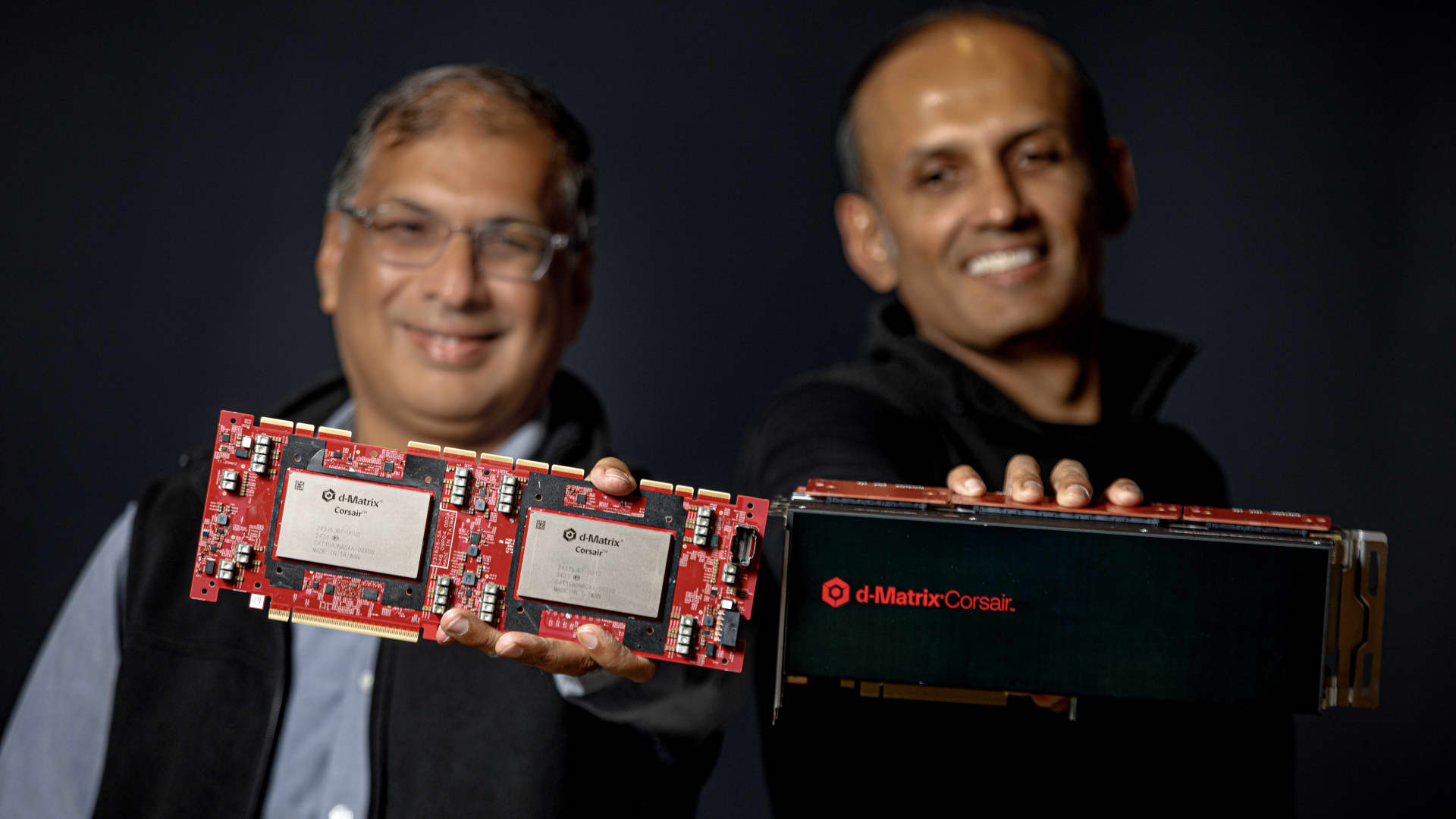
The intensely competitive AI chip market is witnessing a new challenger as D-Matrix, a Silicon Valley startup backed by Microsoft, unveils its Corsair inference chip. Positioned just miles from Nvidia’s headquarters, D-Matrix is making bold claims about its chip’s performance and efficiency for specific AI workloads, signaling a potential shift in how companies approach AI infrastructure. This emergence highlights a broader trend of specialized silicon solutions gaining traction against general-purpose GPUs.
🚀 Tech Strategy & Market Disruptions
- Niche Performance Advantage. D-Matrix’s Corsair chip promises up to 10x faster inference and 5x less energy consumption for smaller AI workloads compared to Nvidia’s GPUs, capitalizing on a specific market segment.
- SRAM-Centric Design. By utilizing SRAM, D-Matrix bypasses the DRAM supply chain constraints affecting traditional GPUs, offering a unique architectural approach that integrates memory and compute tightly.
- Hyperscaler Adoption & Microsoft Backing. The startup has secured commitments from high-profile hyperscalers and frontier AI labs, with strategic backing from Microsoft’s M12 venture arm, validating its market potential and technological approach.
The AI chip landscape, largely dominated by Nvidia, is increasingly attracting specialized contenders. D-Matrix, founded in 2019, is the latest to enter the fray with its Corsair chip, which the company asserts delivers significant performance and energy efficiency gains for AI inference tasks, particularly those involving smaller data sets. Co-founder and CEO Sid Sheth noted in a CNBC interview that its chips are 10 times faster and use five times less energy than a standalone GPU from Nvidia for appropriate workloads. This specialized focus caters to applications demanding low latency and high interactivity, such as chatbots and voice agents, rather than the massive reasoning models that define cutting-edge large language models. The innovation in the emerging technologies sector showcases how startups are carving out niches by optimizing for specific computational challenges.
Unlike traditional GPUs that rely on High Bandwidth Memory (HBM) composed of DRAM, D-Matrix’s Corsair chip leverages SRAM, tightly integrating memory and compute on a single chip. This approach mirrors strategies employed by other challengers like Cerebras and Groq, both of whom have seen significant market activity; Cerebras recently completed a substantial IPO, and Nvidia acquired Groq for $20 billion. A key advantage of the SRAM design, as explained by Sheth, is its independence from the prevalent DRAM supply shortages that have impacted major memory providers like Micron, Samsung, and SK Hynix. This strategic pivot reduces a significant chokepoint in the supply chain.
The firm has garnered substantial investment, raising approximately $500 million to date, valuing it at around $2 billion. Notably, Microsoft, through its M12 venture arm, is a significant investor. This backing is particularly interesting given Microsoft’s expanding chip ambitions, which include its own Maia 200 AI inference chip, new PC processors built with Nvidia, and even an in-house quantum computing chip. D-Matrix has secured commitments from major hyperscalers, neoclouds, and frontier AI labs, with shipments commencing this month, primarily to U.S. customers and some in the Middle East and Southeast Asia. Semiconductor analyst Stacy Rasgon of Bernstein Research observed that these specialized chips are often used in conjunction with Nvidia’s offerings, highlighting their complementary rather than purely competitive role. Exploring such technology market trends provides valuable insights into industry evolution.
However, the SRAM-based architecture has a recognized limitation. Rick Bahr, an adjunct professor of electrical engineering at Stanford University, pointed out that while SRAM provides ‘remarkable inference speeds’ due to short data travel distances, it cannot accommodate the trillions of parameters found in very large models from companies like OpenAI and Anthropic. This defines D-Matrix’s operational boundary, emphasizing its role in optimizing interactivity and speed for specific AI inference tasks rather than handling colossal language models. The company even suggests that when Corsair is paired with an Nvidia Blackwell GPU, it can run inference 10 times faster, three times cheaper, and up to five times more energy-efficiently than a standalone GPU, according to Gimlet Labs research.
- D-Matrix’s Corsair targets AI inference, specifically for low-latency, interactive applications like chatbots and voice agents.
- Its SRAM architecture helps avoid DRAM supply chain bottlenecks, a common issue in the current chip market.
- Microsoft’s investment signals confidence in D-Matrix’s technological approach and its potential role in a diversified AI compute ecosystem.
DISRUPTION FLOW: The introduction of D-Matrix’s Corsair chip, leveraging a novel SRAM architecture, initiates a distinct disruption flow in the AI chip market. This specialized design allows for significantly lower latency and power consumption for smaller inference workloads. This translates into faster processing for interactive AI applications such as chatbots and digital assistants, enabling hyperscalers to optimize their infrastructure for specific use cases. The consequent reduction in energy consumption further lowers operational costs, creating a compelling value proposition. Ultimately, this leads to a diversification of AI compute offerings, moving beyond Nvidia’s generalized GPU dominance towards a multi-vendor environment where specialized chips coexist and even complement existing hardware, fostering innovation-driven growth across the AI stack.
‘The emergence of D-Matrix with its SRAM-focused approach is a testament to the ongoing specialization within the AI silicon space. As AI models become more diverse in their computational requirements, architecting for specific inference tasks, especially those prioritizing speed and energy efficiency over raw parameter count, becomes critical for scalable and cost-effective deployments.’
| Metric | D-Matrix Corsair (vs. standalone GPU) | D-Matrix Corsair + Nvidia Blackwell (vs. standalone GPU) |
|---|---|---|
| Inference Speed | 10x Faster | 10x Faster |
| Energy Efficiency | 5x Less Energy | Up to 5x More Energy Efficient |
| Cost Efficiency | Not specified | 3x Cheaper |
D-Matrix Platform Architecture: Specialization for Performance
The core of D-Matrix’s innovation lies in its unique platform architecture, particularly its reliance on SRAM (Static Random-Access Memory) for on-chip memory. This contrasts sharply with the HBM (High Bandwidth Memory) DRAM stacks typically employed by Nvidia’s GPUs. By integrating SRAM directly onto the chip, D-Matrix minimizes the physical distance data must travel between memory and compute units, drastically reducing latency and energy consumption for specific workloads. This tight coupling allows for ‘compute-in-memory’ paradigms that are exceptionally efficient for inference tasks where data locality is paramount. The Corsair chip is sold as a card containing four chips, designed for plug-and-play integration into data center server racks, offering up to 128 gigabytes of SRAM memory per server. This rack-scale system, dubbed SquadRack, is built in collaboration with partners like Arista, Broadcom, and Super Micro, emphasizing an integrated solution ready for immediate deployment.
D-Matrix Market Adoption Challenges: Scaling Beyond Niche
While D-Matrix demonstrates clear performance advantages for specific AI inference workloads, its path to broader market adoption faces inherent challenges. The primary hurdle, as highlighted by Stanford’s Rick Bahr, is the limitation of SRAM-based designs in handling the massive parameter counts of leading-edge generative AI models from labs like OpenAI and Anthropic. This effectively confines D-Matrix to a niche market of interactive AI applications, preventing it from addressing the full spectrum of AI compute demands. Furthermore, competing against Nvidia’s comprehensive ecosystem, which encompasses not only advanced GPUs but also a vast software stack and developer community, requires significant strategic agility. D-Matrix must convince hyperscalers and enterprises that its specialized efficiency gains outweigh the benefits of Nvidia’s established platforms and the potential complexity of managing a heterogeneous hardware environment. The long-term success of the company will depend on its ability to expand its applicable workload scope or deeply integrate into existing ecosystems to become an indispensable companion to larger, more general-purpose AI accelerators. For more on such developments, readers can explore the latest educational tech insights.
D-Matrix’s Ascent: Redefining AI Inference Efficiency
D-Matrix represents a crucial evolutionary step in the fragmented AI chip market, proving that innovation can thrive in specialized segments even against entrenched giants. Its focus on low-latency, energy-efficient inference for interactive AI applications addresses a growing demand, offering a compelling alternative to general-purpose GPUs.
- The Corsair chip’s SRAM architecture delivers tangible performance benefits for specific AI inference tasks.
- Strategic backing from Microsoft validates D-Matrix’s technological approach and market potential.
- The inherent limitations with massive models pose a challenge for broader market dominance but define a clear, valuable niche.
Will D-Matrix’s specialized approach pave the way for a more diverse and competitive AI hardware ecosystem?
📊 StockXpo Analyst’s View
Market Impact: D-Matrix’s emergence introduces a new layer of complexity and opportunity into the AI chip market. While Nvidia retains its commanding lead in training and large-scale inference, specialized players like D-Matrix could erode market share in specific inference workloads, particularly where cost and energy efficiency are paramount. This could lead to a more fragmented procurement strategy among hyperscalers, potentially benefiting smaller, agile chip designers and reducing overall dependence on a single vendor. The Microsoft backing also signifies a strategic move by a major cloud provider to diversify its AI infrastructure options.
Sector To Watch: Investors should closely watch the ‘neocloud’ and frontier AI lab sectors. These entities are often at the forefront of optimizing AI workloads and are keen to adopt hardware that offers a competitive edge in performance or cost. Furthermore, companies heavily investing in real-time, interactive AI applications such as advanced chatbots, virtual assistants, and agentic AI tools will be early beneficiaries and indicators of D-Matrix’s traction. The semiconductor manufacturing sector, specifically foundries like TSMC, will also continue to be critical enablers for these innovative chip designs. For deeper analysis of market movements, refer to Bloomberg Technology.
Financial Disclaimer:
StockXpo.com is a financial news aggregator and educational portal, not a registered investment advisor or broker-dealer. All information, news, and analysis provided herein are strictly for educational purposes and do not constitute investment, financial, legal, or tax advice. Investing in the stock market involves high risks, and past performance is not indicative of future results. StockXpo will not be liable for any financial losses or investment damages. Always consult a certified financial advisor before making market decisions.
MORE IN INSIDE TECHNOLOGY

SpaceX AI Chips: $40 Billion Deal Fuels Innovation-Driven Growth
Published: Sunday, October 25, 2026 · 9:35 PM
AI Buildout Hits Credit Headwinds: Neoclouds Under Pressure
Published: Saturday, October 24, 2026 · 12:23 AM