
Published: Friday, August 14, 2026 · 12:37 AM | Updated: Thursday, September 3, 2026 · 9:08 AM
📊 76 views




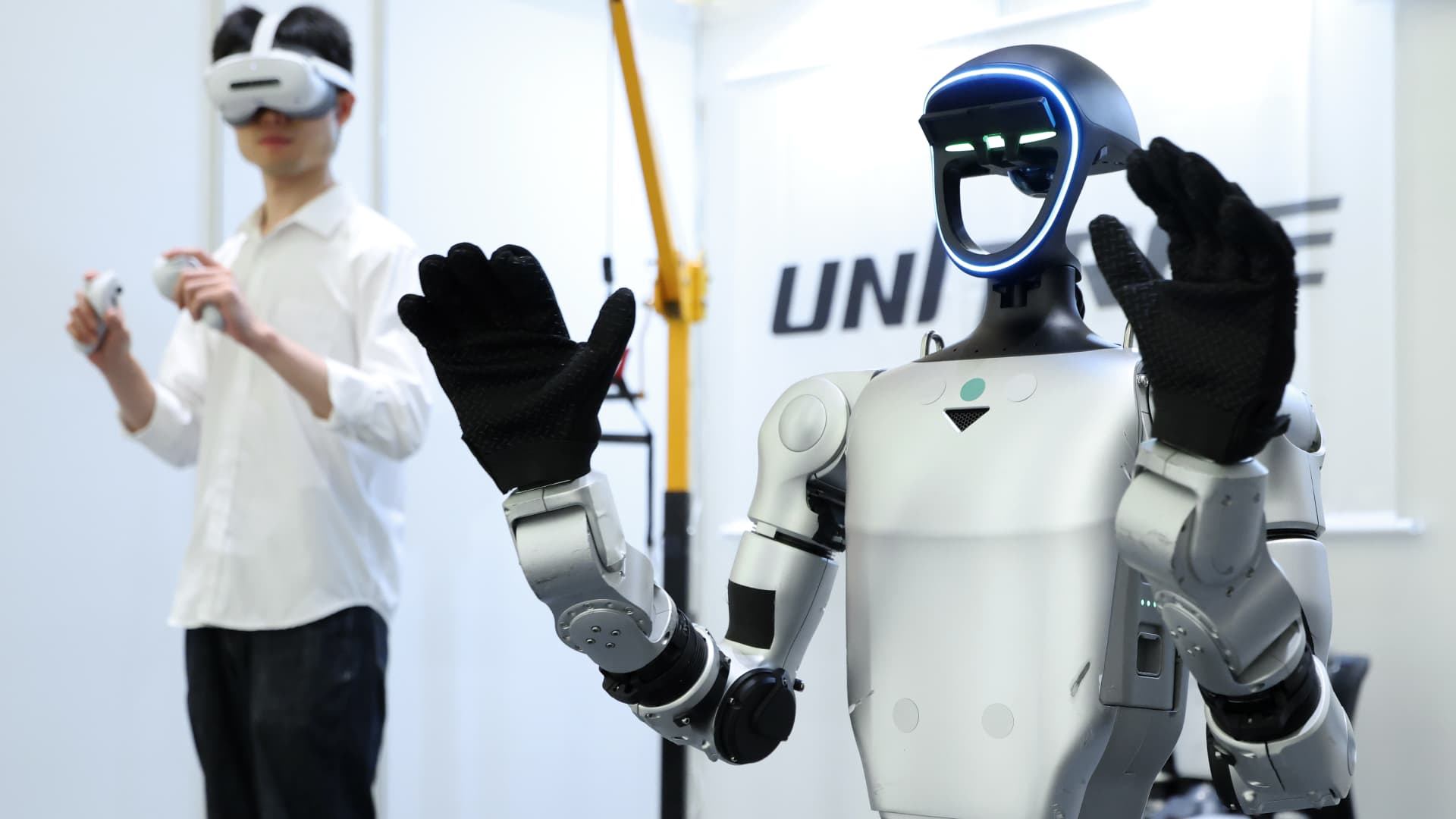
China’s Unitree Robotics has made headlines with a blockbuster IPO, valuing the company at $9 billion amidst feverish retail demand. While the startup’s acrobatic humanoid robots captivate investors, deep questions persist regarding their commercial viability beyond research and demonstration. The market is buzzing, but can these advanced machines truly transition from impressive feats to practical, revenue-generating applications?
🚀 Tech Strategy & Market Disruptions
- IPO Frenzy vs. Practicality. Unitree’s $9 billion IPO highlights speculative investor appetite for the emerging humanoid robotics sector, despite ongoing challenges in commercial scalability and functional autonomy.
- Cost Reduction & Market Dominance. China, led by Unitree, is leveraging lower-cost manufacturing to drive down humanoid robot prices significantly, aiming for global dominance in a market projected to reach 10 million units by 2035.
- Geopolitical Headwinds & Tech Dependencies. U.S. import bans and potential restrictions on critical Western components, particularly Nvidia’s AI hardware and software, pose substantial risks to Chinese robotics firms despite China’s rare earth advantages.
Unitree Robotics, a Hangzhou-based startup, recently launched its IPO on Shanghai’s STAR market at 150.8 yuan ($22.4) a share, raising $900 million and achieving a staggering $9 billion valuation. This public offering saw unprecedented retail demand, with the online tranche oversubscribed over 5,000 times, resulting in a microscopic 0.018% lot-winning rate. Such enthusiasm is partly fueled by the scarcity of pure-play humanoid robotics investments, as noted by Hao Hong, managing partner of Lotus Asset Management.
Despite the market’s excitement, fueled by impressive demonstrations of its robots’ agility and backflipping capabilities, skepticism about their practical utility persists. Hong remarked, ‘For these humanoid robots, to be honest, they’re fascinating. They can dance and all that – but never seen them doing any real housework.’ Unitree’s own prospectus acknowledges that large-scale commercial adoption may be slower than anticipated due to limitations in robotic hand precision and durability.
Dominik Pross, an equity analyst at VP Bank, further highlights the current operational constraints, stating that even advanced humanoid models typically handle only a limited number of tasks for a few hours before requiring a recharge. Most models operate for up to four hours while idle. He emphasizes that robots must be specifically trained for each individual task, indicating that complex, unstructured everyday activities remain beyond their current capabilities. This technological hurdle forms a significant barrier to widespread adoption across various industries and consumer applications. Investors should monitor global technology news for realistic deployment metrics rather than just growth projections.
China’s prowess in lower-cost manufacturing has positioned it as a leader in robotics, accounting for over 70% of global industrial robot installations and nearly 90% of all humanoids deployed last year, according to Wood Mackenzie. The research firm projects the global humanoid robot fleet to surge more than 90% annually through 2035, exceeding 10 million units, with annual shipments projected to top 4 million. This rapid expansion is underpinned by a dramatic price reduction: average humanoid robot prices have plummeted 93% between 2020 and 2025 to $58,000. Unitree’s flagship G1 model, priced at $16,000, incurs an estimated electricity cost of just $82 per year for eight hours of daily operation.
Government support, encouraging domestic manufacturers to transition from labor-intensive work to automation, further fuels this sector’s growth. While higher production volumes contribute to cost reduction, Linda Sui, founder of Smart Analytics Global, stresses that proving the robots’ return on investment will require time and real-world deployment. Unitree’s revenue quadrupled last year, but Q1 adjusted profit declined over 52% due to increased R&D and marketing expenditures. The current demand is largely concentrated in research and demonstrations, with nearly three-quarters of its humanoid revenue in the first nine months of 2025 derived from research and education.
The rapid decline in humanoid robots‘ production costs, driven by Chinese manufacturing scale, directly enables broader accessibility for research institutions and early industrial adopters. This accessibility in turn accelerates iterative development and pushes the boundaries of AI and software integration for robotic control. The ensuing innovation cycle, if successful, could disrupt labor-intensive industries by automating tasks currently performed by humans, potentially reshaping manufacturing, logistics, and service sectors globally. However, the lack of general-purpose AI and dexterous manipulation remains a bottleneck, preventing these advancements from translating into mass commercial disruption outside niche applications. The speculative investment wave, as seen with Unitree’s IPO and its pre-IPO perpetual contract trading at four times its listing price on Hyperliquid, indicates market anticipation of future disruptive potential rather than current commercial ubiquity.
The core challenge for advanced robotics, particularly humanoids, lies in bridging the gap between sophisticated motor control and cognitive flexibility. Achieving true commercial scalability requires a paradigm shift in AI’s ability to interpret, adapt, and perform complex, unstructured tasks autonomously without extensive, task-specific training. This is where the long-term value will truly unlock.
Key Humanoid Robotics Market Metrics
| Metric | Details |
|---|---|
| Unitree IPO Valuation | $9 billion (61 billion yuan) |
| Global Humanoid Fleet Growth (2025-2035) | Projected >90% annually to surpass 10 million units |
| Average Humanoid Price Decline (2020-2025) | 93% plunge, from ~$828,000 to $58,000 |
| Unitree G1 Model Price | $16,000 |
| Unitree G1 EDU Model Gross Margin | 67% (on $27,300 price) |
| China’s Share of Global Humanoid Deployments | Nearly 90% (last year) |
Unitree Market Adoption Challenges
Despite its impressive technological feats and aggressive pricing strategy, Unitree faces significant headwinds in achieving widespread market adoption. The company’s own filings indicate that nearly three-quarters of its humanoid revenue in the first nine months of 2025 originated from research and education sectors, with corporate tours making up a substantial portion of its industrial business. This suggests that while Unitree has succeeded in capturing the attention of R&D institutions and showcasing its capabilities, conversion to genuine commercial utility remains limited. The primary hurdles include the inherent complexity of training robots for diverse, unstructured tasks, the precision and durability limitations of robotic hands, and the relatively short battery life that restricts continuous operation. Overcoming these will require not only hardware advancements but also significant breakthroughs in artificial intelligence and machine learning to enable greater autonomy and adaptability.
Unitree Ecosystem Expansion Potential
Unitree’s long-term growth hinges on its ability to expand beyond its current research and demonstration strongholds into viable commercial ecosystems. The focus on lower-cost manufacturing provides a distinct advantage, potentially opening up markets in developing economies or for applications where cost is a primary driver. The company’s engagement with strategic investors, such as AI startup DeepSeek, points to a recognition of the need for robust software and AI integration to enhance robot functionality. Developing a platform that supports third-party application development or specialized task modules could significantly broaden the utility and addressable market for their humanoid robots. Furthermore, leveraging its expertise in quadruped robots, which currently account for a sizable share of its business, could provide a more immediate and reliable revenue stream in industrial settings where purpose-built robots often outperform humanoids in repetitive tasks. The potential for partnerships with logistics, manufacturing, and healthcare providers to co-develop industry-specific solutions could be a critical path for ecosystem expansion, positioning Unitree to capitalize on the broader trends in automation, as highlighted by new technological frontiers.
Unitree Robotics: Navigating Commercialization Hurdles and Geopolitical Headwinds
Unitree Robotics’ spectacular IPO reflects significant market optimism for the humanoid sector, yet the path to widespread commercial adoption is fraught with technical and geopolitical challenges. The company’s valuation appears to be driven by future potential rather than proven revenue streams from practical applications. Sustained growth will require substantial innovation in AI and hardware, along with adept navigation of international trade restrictions.
- The current demand for Unitree’s robots is heavily skewed towards research and educational purposes, indicating a gap in viable industrial or consumer applications.
- While cost-effective manufacturing gives Unitree a competitive edge, performance limitations in precision, durability, and battery life remain critical barriers to scalability.
- Geopolitical tensions, including U.S. import bans and potential restrictions on crucial components like Nvidia’s AI stack, present tangible risks to Unitree’s global market access and technological advancement.
Can Unitree effectively transform speculative excitement into sustainable, practical revenue generation amidst a complex global technology landscape?
📊 StockXpo Analyst’s View
Market Impact: Unitree’s IPO underscores a speculative fervor in the robotics market, indicating investor readiness to bet on disruptive potential even without immediate commercial proof. This could trigger further listings from rivals like AgiBot and Leju Robotics, inflating valuations across the nascent humanoid sector. However, the disconnect between impressive capabilities and actual utility could lead to volatility as commercialization timelines extend. Investors should monitor financial news and broader technology market trends carefully for realistic deployment metrics rather than just growth projections.
Sector To Watch: The robotics sector, particularly humanoid and industrial automation, warrants close observation. China’s dominance in manufacturing scale and rare earth materials gives its domestic players unique leverage, yet reliance on Western AI and semiconductor components introduces critical supply chain risks. Companies demonstrating tangible ROI in specific industrial applications, alongside robust AI development, will likely emerge as long-term leaders, providing valuable educational tech insights for those exploring this space.
Financial Disclaimer:
StockXpo.com is a financial news aggregator and educational portal, not a registered investment advisor or broker-dealer. All information, news, and analysis provided herein are strictly for educational purposes and do not constitute investment, financial, legal, or tax advice. Investing in the stock market involves high risks, and past performance is not indicative of future results. StockXpo will not be liable for any financial losses or investment damages. Always consult a certified financial advisor before making market decisions.
MORE IN INSIDE TECHNOLOGY

State-Backed Dating App Innovation: Singapore’s Bold Demographic Tech Strategy
Published: Sunday, October 4, 2026 · 3:36 AM

Data Centers Face Global Headwinds: A $119 Billion Investment at Risk
Published: Saturday, October 3, 2026 · 2:48 AM


